
The Architecture of Resilient Portfolios: Allocation Under Uncertainty
One of the most persistent illusions in financial modeling is that greater precision leads to better decisions. In reality, increasing model complexity often amplifies estimation error rather than reducing it. The true objective of portfolio design is not predictive accuracy, but robustness to being wrong.
The Challenge: The "Optimization Paradox"
Standard financial theory often relies on Mean-Variance Optimization (MVO). It asks a simple question: What is the best return I can get for a specific level of risk?
The Belief: If we input historical returns and volatilities, the computer will output the "Optimal Portfolio."
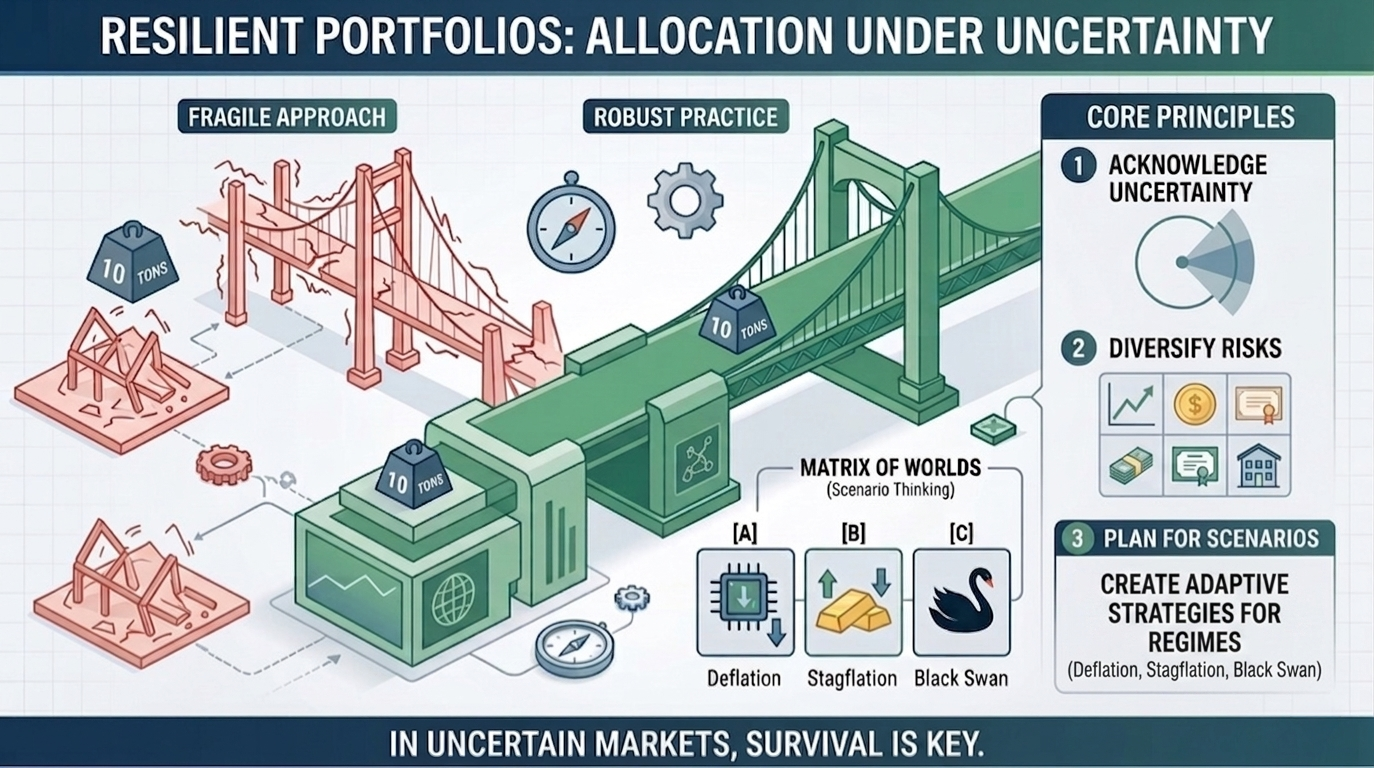
The Reality: This creates a "fragile" allocation. Because the model treats historical data as a fixed truth the optimizer concentrates capital in assets with the highest estimated return, making the result extremely sensitive to small estimation errors. This is known as overfitting to the past.
Better Practice: Managing Uncertainty vs. Managing Risk (Knight, 1921)
To move beyond basic modeling, practitioners must separate Risk (measurable volatility) from Uncertainty (the structural unknown).
1. Confidence Intervals Over Point Estimates
A point forecast says: "Asset A will return 8%." A robust practice says: "Asset A has an expected return of 8%, but the standard error of that estimate is 4%."
When you acknowledge the width of the interval, you stop betting on a single outcome. This perspective naturally leads to shrinkage estimators, where extreme historical observations are partially “pulled” toward a broader market average. The goal is to reduce the influence of noisy or anomalous historical data, acknowledging that extreme past outcomes rarely repeat with the same magnitude.
2. Scenario Thinking: Modeling the "Correlation Breakout"
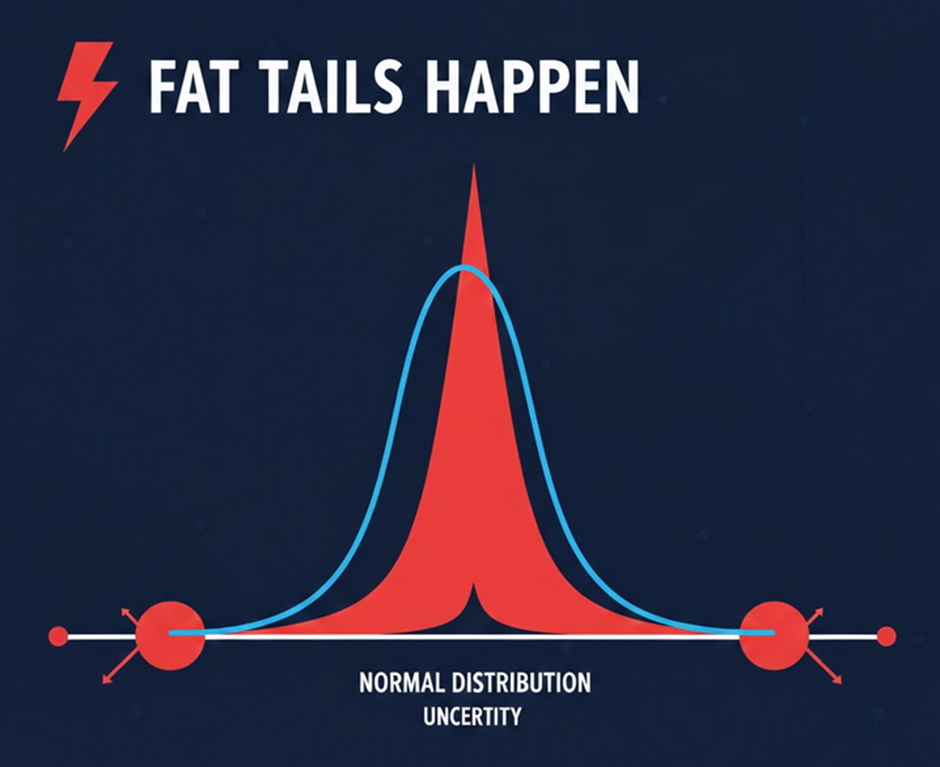
The fatal flaw of most portfolios is the assumption that correlations are static. In a stable market, stocks and bonds might move in opposite directions. In a systemic crisis, they often collapse together.
The Advanced Practice: Instead of one forecast, create a Matrix of Worlds:
World A (Deflationary): High-growth tech thrives; commodities crash.
World B (Stagflationary): Equities struggle; gold and inflation-linked bonds lead.
World C (The "Black Swan"): Liquidity evaporates; only cash and volatility hedges survive.
By weighing the portfolio across these "Worlds," you aren't trying to guess which one will happen. You are ensuring that no single "World" can destroy the total capital base.
Real-World Implication: Risk-Aware Decision Making
In practice, this principle is implemented through risk budgeting or Kelly-style position sizing, where the size of an investment reflects both its expected return and the uncertainty around that estimate.
If a forecast has high uncertainty (a wide confidence interval), the "Best Practice" is to reduce the position size, even if the potential upside is massive. This is the application of the Margin of Safety. In engineering, if a bridge must hold 10 tons, you build it to hold 50. In finance, if you need a 5% return to meet your goals, you model for a world that only gives you 2%.
The Hierarchy of Allocation
1. Estimation Discipline: Acknowledge that historical data is noisy and uncertain.
2. Diversification Across Risk Drivers: Allocate across fundamentally different economic exposures rather than simply holding many similar assets.
3. Systematic Rebalancing: Exploit volatility by trimming assets that have become expensive and reallocating toward those that have become relatively cheap.
Conclusion: The Analytical Edge
The transition from a "forecast-driven" strategy to an "uncertainty-aware" strategy marks the difference between an amateur and an institutional thinker. It requires the discipline to prioritize Confidence Intervals over Single Numbers and Survival over Optimization.
Accuracy alone isn’t enough. In uncertain markets, survival is the first objective of capital allocation.
The most successful strategies are not those that predict the future correctly most often, but those that remain resilient when the future inevitably proves them wrong.